A 3D model that sells apartments in line with the price transparency act
Since 11 July 2025, every developer in Poland must openly publish apartment prices, keep them up to date and report them daily to a government portal. Method Group turns this obligation into an advantage for the developer: it builds an interactive 3D model that presents the required, always-current prices to buyers in an attractive form — and, wired live to the sales system, it maintains compliance from a single source while genuinely supporting sales.
Price transparency: the developer's new reality
The housing price transparency act (Dz.U. 2025.758) has been in force since 11 July 2025. Developers must publish the price of every unit on their website, keep it up to date, report the data daily to the government portal dane.gov.pl, and store the price-change history for at least 12 months and make it available to buyers on request. Non-compliance carries a UOKiK penalty of up to 10% of annual turnover — this is not a risk to sit out.
In practice, most firms handle this by hand: someone updates the price list in Excel, copies it onto the website, sends it separately to the government portal, and the sales reps work off their own version in the CRM anyway. Four or five places with the same data — and a certainty that sooner or later they will drift apart. Method Group approaches this from the developer’s benefit: since prices have to be public and current anyway, they can be presented so they actively help sell — rather than being just a box to tick.
The 3D model, not just a render
The starting point is a rotatable 3D model of the entire development — not a static render, but a living tool. The building can be rotated a full 360 degrees, viewed from all four cardinal directions and at different times of day, zoomed in on detail, and even explored via a 360° walk through the garden. Apartment availability is colour-coded directly on the building’s mass — you can see at once what is available, reserved and sold, without reading a table.
This is not a visualisation for its own sake. Every apartment on the model is clickable. A click opens the unit card: floor area, number of rooms, floor, layout, price and price per square metre, plus the current status. The buyer does not have to call to ask “is this still available” — they see it themselves, at any time.
The finder: buyers reach their own home
The 3D model comes with a full apartment finder. Buyers filter the offer by floor, number of rooms, floor area, price and price per square metre — and in a few seconds narrow the list down to the apartments that genuinely interest them. Separate tabs lead to the full list of apartments, tenant storage units, parking spaces and the development's key features. Everything works the same on desktop, tablet and phone: on a large screen in the sales office and on the buyer's phone at 11 p.m.
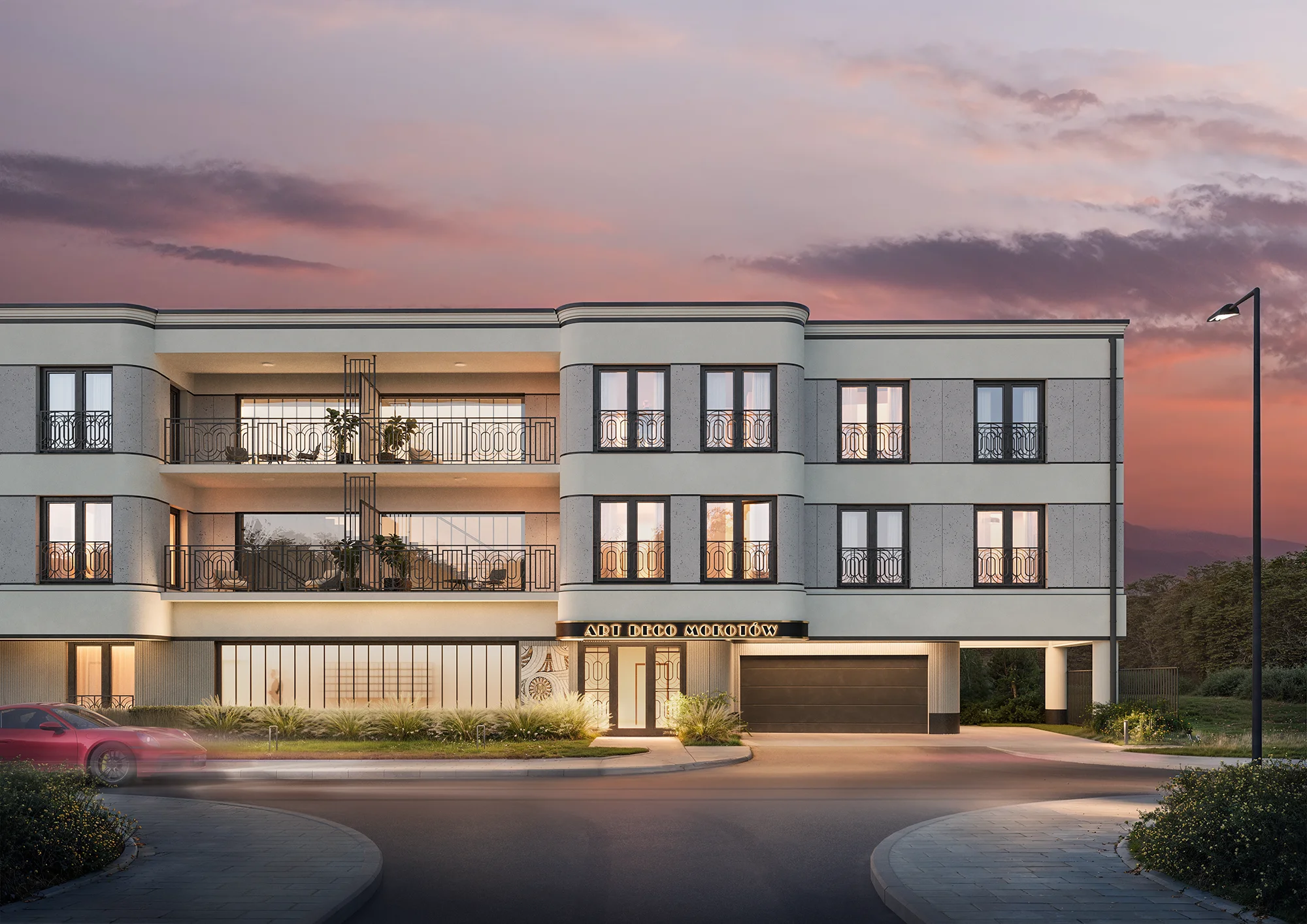
It is best seen in action. Below is a model built on a real project — the Art Deco development in Mokotów, delivered for the developer Terra Casa. You can rotate the building, open the filters and click on a specific apartment:
A Method Group presentation on the Art Deco Mokotów project (developer Terra Casa). The data and statuses in the demo version are indicative and changed for the presentation — the current offer is available from the developer. In the production version, data is pulled live from the sales system.
Case study: Art Deco Mokotów, the Pola building
The Pola building model covers 28 apartments spread across three storeys — the ground floor plus the first and second floors — ranging from roughly 44 to 140 m². Added to that are 39 parking spaces, two bicycle rooms and tenant storage units, all accessible from the model via separate tabs. The version above is a presentation: we changed some statuses and data for the demo, and the current offer is available from the developer.
One source of truth, not five price lists
The heart of the solution is what you cannot see. The model has no prices “hard-coded” — it connects read-only directly to the developer’s sales system. For clients using DEWELOPER System (Forbit) we have a ready, working connector; for other CRMs we plug into their API, and if a developer does not yet have a system, we set up the data layer on their side. The developer changes a price in one place, in their own system, and the change appears automatically: on the model, on the website and in the data sent to the government portal.
This solves the core problem with the act. There are no five versions of the price list, because there is one source of truth. Prices are always current (an act requirement), change history records itself (the 12-month requirement), and daily reporting stops being manual work that can fail any given day. Compliance emerges as a by-product of a well-built system, rather than a separate obligation to police.
Benefits for buyers and developers
- ▪Full transparency — the buyer sees what is available and at what price, with no phone calls or “is this still current” questions.
- ▪A faster decision — from “browsing the development” to “asking about a specific apartment” in a few clicks.
- ▪Compliance with the act without manual work — up-to-date prices, change history and the dane.gov.pl report from a single source.
- ▪Premium-grade sales material — a 3D model instead of a dry table; the same “wow” as a render, but with live data.
- ▪Consistency across website, CRM and government portal — one source, so the data never drifts apart across channels.
- ▪A lighter load on sales and better leads — the buyer asks about a specific unit, not “what do you have available”.
Creative Hub: the same data for the team
The 3D model is the front end — what the client sees. But the same data can be turned inward. Creative Hub is the developer team's internal panel that ties together three streams: the live offer from the sales system (prices, floor areas, statuses), marketing and sales materials, and the sales knowledge that usually gets lost in email — FAQs, objections, decisions. Sales reps, marketing and management all work off one, always up-to-date base.
Management gets a clear view and a recurring report without having to ask for spreadsheets, the sales rep gets a complete set of current materials and answers to hand, and built-in AI answers questions about the offer and documents in seconds. A front end for the client and a back office for the team on the same data source — the natural next step after launching the model. Method Group applied the same approach to the Soho development as well.
Want to see how a system like this could work for you? Book a free consultation with Method Group →
“The price transparency act is not just another box to tick. It is data you have to show anyway — so let it sell. Instead of a table in a PDF, we build a model where buyers find their own apartment with its current price, and the developer has a single source of truth instead of five places to update by hand” — Wiktor Pasternak, co-founder of Method Group.
Method Press editorial material. The solution described — the 3D model, apartment finder, connector to the sales system and Creative Hub — is built and deployed by Method Group. The model presentation was created on the Art Deco Mokotów project delivered for the developer Terra Casa; the data and statuses in the demo version are indicative. Legal status: the housing price transparency act (Dz.U. 2025.758), in force since 11 July 2025.