How much CO₂ is in your façade? The carbon footprint of glass in buildings
Glass is one of the most energy-intensive façade materials — but, when properly designed, it can give back more in use than it cost to produce. How to calculate the real carbon footprint of glazing across a building's entire life cycle, and which technologies reduce it — Pilkington's experts explain.
Modern construction is increasingly viewed through the lens of total carbon footprint — not only during use, but across a building’s entire life cycle. Glass, as one of the key façade materials, plays an important role here. Its production is energy-intensive, yet well-designed glass solutions can significantly cut a building’s energy use. So how do we assess the real impact of glass on CO₂ emissions, and which technologies help to minimise it?
The life cycle of glass and a building's emissions balance
Assessing the carbon footprint of glass requires a holistic approach, in line with the LCA (Life Cycle Assessment) methodology, which accounts for both embodied carbon and operational carbon. For glazing this distinction is particularly important — glass generates emissions at the production stage but also affects energy consumption throughout the building’s entire service life.
The production of float glass is among the most energy-intensive processes in the building-materials industry. The melting temperature of the raw materials exceeds 1,500°C, which entails high CO₂ emissions — both process emissions (from the decomposition of carbonates) and energy emissions. According to International Energy Agency analyses, the building-materials sector accounts for around 9–10% of global CO₂ emissions, and the glass industry alone generates several per cent of industrial emissions in Europe.
From a building’s perspective, this means glass makes a significant contribution to embodied carbon. As the World Green Building Council notes in its report ‘Bringing Embodied Carbon Upfront’, buildings are responsible for nearly 39% of energy-related global CO₂ emissions, of which around 11% comes from material production and construction itself. Moreover, according to that report, emissions arising before a building is even handed over — so-called upfront carbon — will account for as much as half of the total carbon footprint of new construction through to 2050.
At the same time, glass remains one of the few materials with a direct, measurable impact on a building’s energy balance. Parameters such as the heat transfer coefficient (U), solar energy transmittance (g) and spectral selectivity determine the scale of heat loss and solar gain. Well-chosen glazing can significantly reduce heating energy demand and, in office buildings, the load on cooling systems too.
– Glass should be assessed over the longer term, explains Magdalena Skoczyńska, Sales Director, Pilkington Polska. The emissions linked to its production are one-off, whereas its impact on energy use plays out over decades. In many cases a well-designed façade cuts operational emissions enough that, in a relatively short time, they offset the embodied carbon.
The importance of this approach is also underlined by the European Commission’s work, including under the Level(s) initiative, which points to the need to monitor both types of emissions in parallel. As requirements on building energy efficiency (the EPBD directive) and carbon-footprint reporting tighten, materials that combine high in-use efficiency with a low production footprint are becoming more important.
The end-of-life stage also plays an important role. Glass can be fully recycled without any loss of raw-material quality, and using cullet in production reduces energy consumption and CO₂ emissions — on average by 2–3% for every 10% of cullet in the batch.
Modern technologies mean lower emissions and greater efficiency
The decarbonisation of the glass sector is currently proceeding along two tracks — by developing products with ever better energy parameters and, in parallel, by reducing CO₂ emissions in the production process.
In terms of performance, advanced low-emissivity and selective coatings are key. Modern insulating glass units achieve a heat transfer coefficient (U) below 0.7 W/m²K while controlling solar energy transmittance. This limits heat loss in winter and reduces overheating in summer which — as International Energy Agency analyses indicate — can translate into a significant reduction in a building’s energy demand, particularly in buildings with large glazed areas.
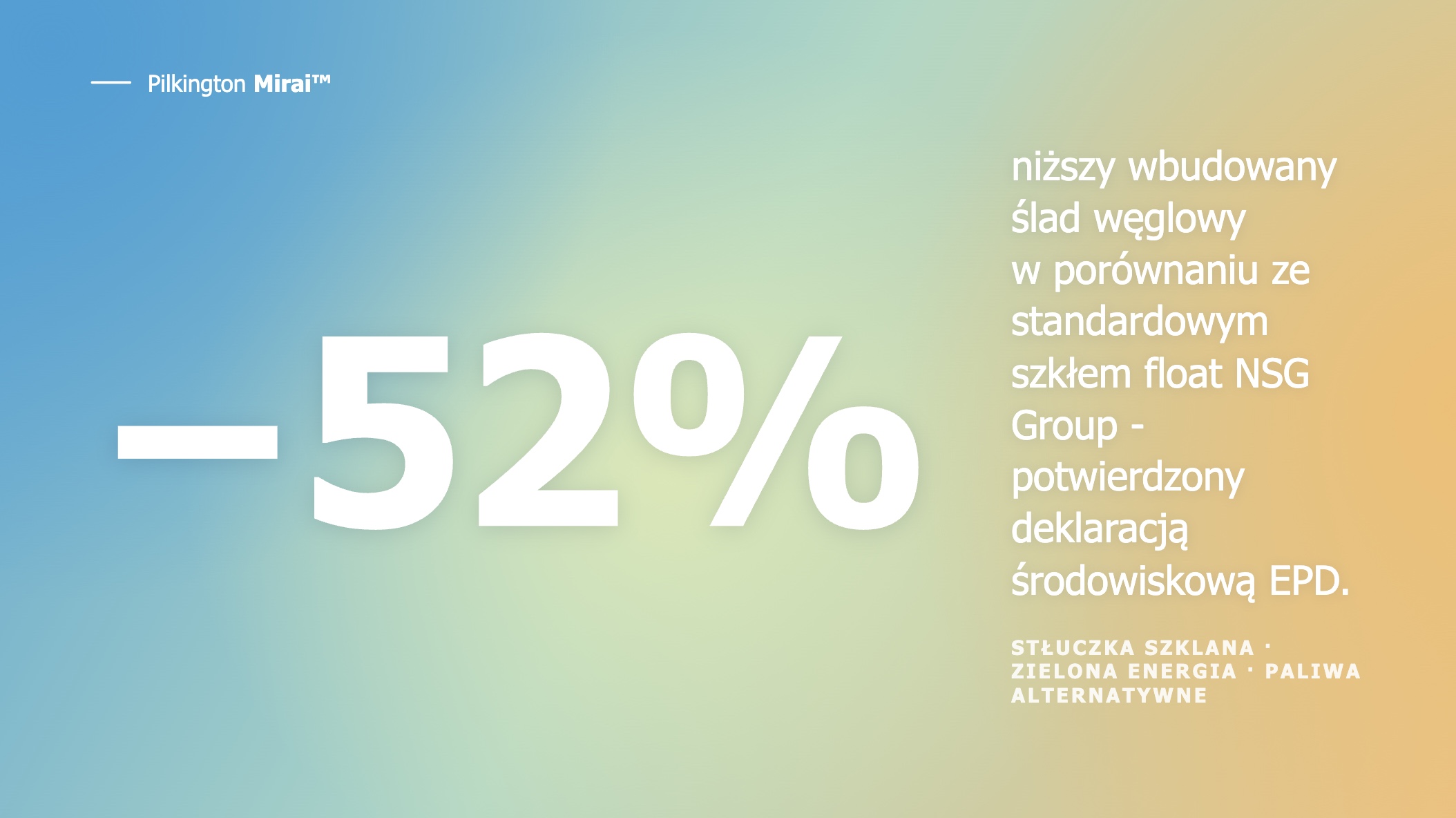
The embodied carbon of materials is, however, becoming increasingly important and will become one of the key criteria for assessing an investment in the coming years. In response to these challenges, technologies that reduce emissions at the production stage are being developed. One example is Pilkington Mirai™ glass, whose embodied carbon is 52% lower than standard float glass produced by NSG Group — independently verified and confirmed by an Environmental Product Declaration (EPD). This was achieved by increasing the share of cullet, using energy from renewable sources and employing alternative fuels in the melting process.
Importantly, this emission reduction does not compromise the material’s performance. The glass can be used in advanced façade solutions, helping to cut emissions at both the production and building-operation stages.
The development of products such as Pilkington Mirai™ is part of NSG Group’s broader climate strategy. The Group has committed to reducing its absolute greenhouse gas emissions (across scopes 1, 2 and 3) by 30% by 2030 against a 2018 baseline — a target approved by the Science Based Targets initiative (SBTi) and consistent with keeping global warming well below 2°C. In the longer term, NSG Group is working towards climate neutrality by 2050.
– The biggest challenge in decarbonising glass is maintaining continuity of the production process while reducing emissions at the same time, notes Magdalena Skoczyńska, Sales Director, Pilkington Polska. Glass furnaces run without interruption for many years, so technological changes have to be introduced gradually. Even today, however, real reductions are achievable by increasing the share of cullet or using green energy.
The significance of these efforts is growing alongside regulatory pressure. According to European Commission announcements, reporting the carbon footprint of buildings across their entire life cycle will become mandatory in the coming years, and requirements on embodied emissions will be progressively tightened.
In this context glass — as a fully recyclable material that also influences energy efficiency — is playing an increasingly important role in the construction sector’s transition towards a low-carbon economy.
Prepared on the basis of a press release from NSG Group / Pilkington IGP, which Method Group is authorised to publish. Quotes: Magdalena Skoczyńska, Sales Director, Pilkington Polska. Graphic: Pilkington IGP press materials.