Four elements, Bauhaus and cooling lava — 13 new Stargres collections for 2026
The manufacturer from Końskie has scripted its catalogue of new arrivals like a story: the Elements series built on the four elements, modernist order in Dessau, the rhythm of pressed wood in Sawdust. And, standing apart, Anatexis — a tile whose edges only darken in the kiln.
A tile manufacturer's catalogue of new arrivals usually reads like a price list: name, format, colour. In 2026 Stargres took a different route — its thirteen new collections form a story about material and its origin. Stone, wood, concrete, mineral, and finally the elements themselves. For an architect this is not decoration: a collection's name and narrative decide whether the material even makes it onto the moodboard, before anyone checks its water absorption.
Elements — four elements as the backbone of the catalogue
The clearest statement is the Elements series, split into four sub-collections corresponding to the elements: Elements Air, Elements Earth, Elements Fire and Elements Water. Each draws on a different material register — from stone texture, through marble, to concrete. Instead of four independent patterns, the manufacturer gets one legible system in which a designer can mix surfaces without losing the coherence of the whole space.
Anatexis — a tile that cools like lava
The most technically interesting collection, however, stands apart. Anatexis was unveiled at the second edition of Architect@Work, and its pattern is created through a process combining digitally applied glue with a granilla topping. This is not a print: the design only completes itself in the kiln, where the tile's edges darken relative to its centre, producing the effect of lava that has just cooled after flowing. The pattern is therefore never fully designed in advance — the kiln finishes it.
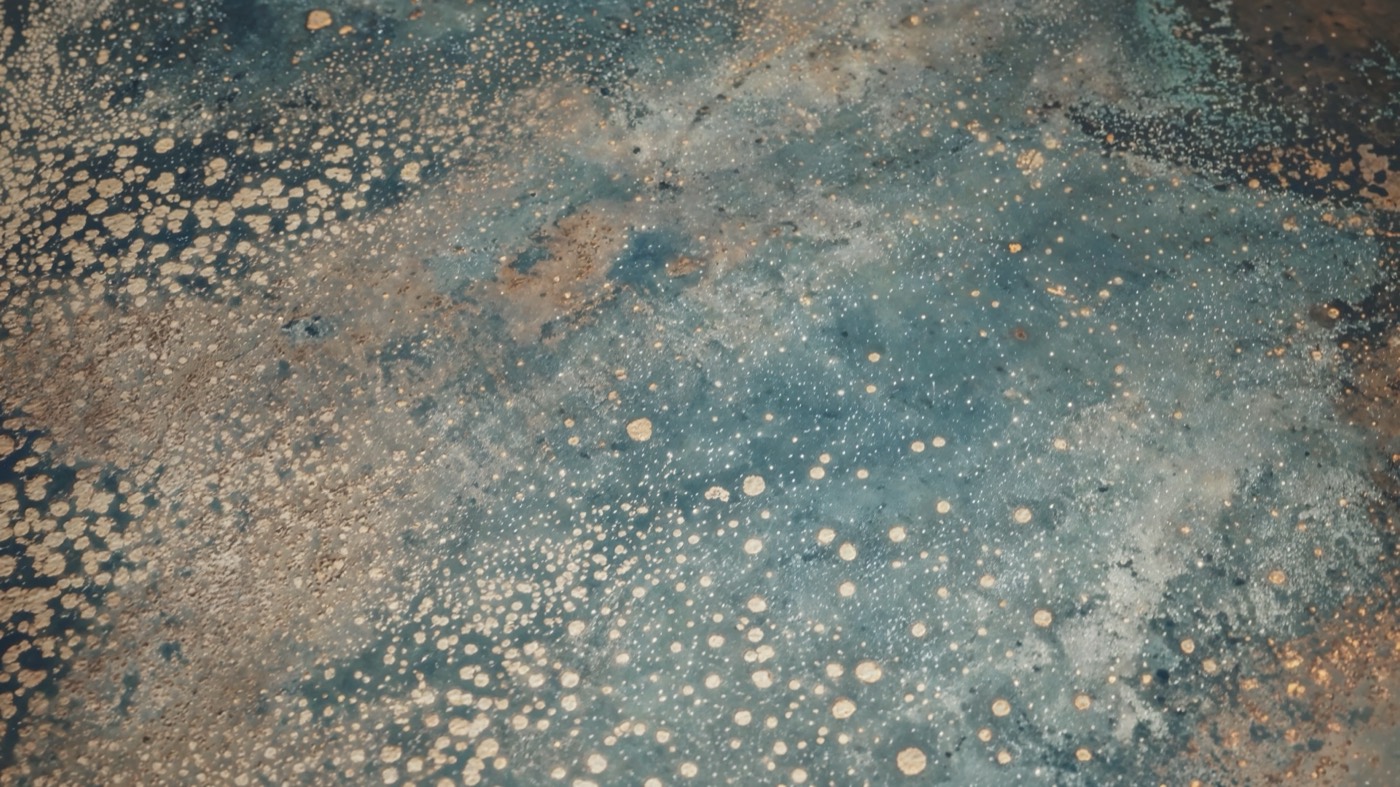
In practice, Anatexis is a black with pronounced veining, available in matt and glossy finishes, aimed at both floors and walls — from the bathroom, through the living room, to a headboard-wall decoration in the bedroom. It is a rare case where the production process itself becomes a sales argument: it is hard to fake an effect that cannot be printed.
Stone retold: Aragonit, Kyanit and Bianero
The second family of new arrivals draws on precious stones. Aragonit reinterprets the beauty of travertine, Kyanit reinterprets onyx, and Bianero offers a modern reading of marble in two finishes: white and deep black. The Kyanit collection, in the 120×120 cm format, lets the monumental scale of the onyx pattern show in representative spaces.
Mineral and modernist order
The third group covers mineral structures: Lateryt, Lunaria (with a terrazzo reading) and Porfir — collections that work on the structure of the material itself rather than imitating a specific stone. Alongside them, Dessau celebrates Bauhaus geometry and the modernist order of form, drawing on the language of concrete. Organic draws on earthy tones and subtle nuances of the natural world, while Sawdust evokes the authenticity of processed wood, faithfully showing the rhythm of pressed fibres.
Why a catalogue of new arrivals is a sales matter
Thirteen collections mean thirteen separate stories, textures, data sheets and files. And this is where the problem begins that touches every premium manufacturer: a material wins the specification not when it is the most attractive, but when it is complete and to hand at the moment the architect decides. Stargres clearly understands this — it provides a texture library with high-resolution graphics, product data sheets and a representative's contact details, and has also added its products to CAD programmes.
For us at Method Press, a collection launch is the moment where the gap between product marketing and a sales system shows most clearly. A good render of a new tile will travel across trade portals within a week. But if three weeks later a sales rep cannot send an architect the current data sheet, texture and model file in under a minute, the launch campaign ends up specifying someone else's product.
Editorial material by Method Press based on official manufacturer sources (stargres.pl — the 'Nowości 2026' / 'News 2026' sections, the source of the list of thirteen collections) and trade coverage from MAGAZIF describing the launch of the Anatexis collection at Architect@Work (digitally applied glue with granilla chips). Product data comes from the manufacturer and may change; full technical parameters for individual collections have not been published. This is not sponsored content.