A space centre several hundred metres underground — an idea for the Wujek Coal Mine's second life
Katowice's Wujek Coal Mine is done with coal. Dr Tomasz Rożek's idea: turn its shafts and galleries into a space technology research centre — a dirty, real-world laboratory of lunar conditions that almost no one else in Europe has.
On Svalbard, in the world's northernmost permanent settlement region, lies Ny-Ålesund. Founded in the early 20th century as a mining settlement, for decades it was a byword for industrial modernity: modern mines, a railway, an Arctic port. When coal stopped paying off, the mine closed and people left. The place could have become a quiet open-air museum. It chose another path — where mining machinery once rumbled, satellite dishes and research stations of more than a dozen countries now stand. Knowledge — about climate, ice, the atmosphere and space — replaced coal as the source of value.
Dr Tomasz Rożek, a science communicator and founder of the 'Nauka. To Lubię' Foundation, wants to repeat that same move — swapping the old fuel of development for a new one — in Katowice. Only not on the Arctic surface, but several hundred metres underground, in the workings of the Wujek Coal Mine.
An idea that 'sounded out of this world'
A few years ago Rożek came up with the idea of using the mine's underground and surface infrastructure to build a modern space technology research centre — including so-called dual-use solutions, serving both civilian and defence applications. At first the idea sounded far-fetched. He first told friends about it, then researchers at the University of Silesia. Together with the foundation's team, and co-authored with Krzysztof Kurdyła, a space market analyst, a report emerged: first an initial version, then a substantially expanded concept working title, 'Space Settlement Simulation Centre'.
The Upper Silesian-Zagłębie Metropolis gave the first green light and named the site: the Wujek Coal Mine itself. Over time the idea won support not only from local government officials and researchers but from the space industry too.
'A space centre underground, in a mine. Seriously? Why not? Can you think of a better place to test technologies and learn to survive in adverse conditions than a deep, dusty mine?' — Dr Tomasz Rożek, 'Nauka. To Lubię' Foundation.
A dirty laboratory that needs no simulation
The heart of the concept is something sterile laboratories can't replicate: realism. Underground workings are a harsh, 'dirty' environment — there's dust, no GPS signal, isolation and tension. That mirrors what awaits the first crews on the Moon and Mars. An analogue habitat several hundred metres underground makes it possible to test how the psyche copes with isolation and how life-support systems behave when contact with the outside world is fully cut off. Crucially, that isolation doesn't need to be simulated — in a mine, it simply exists.
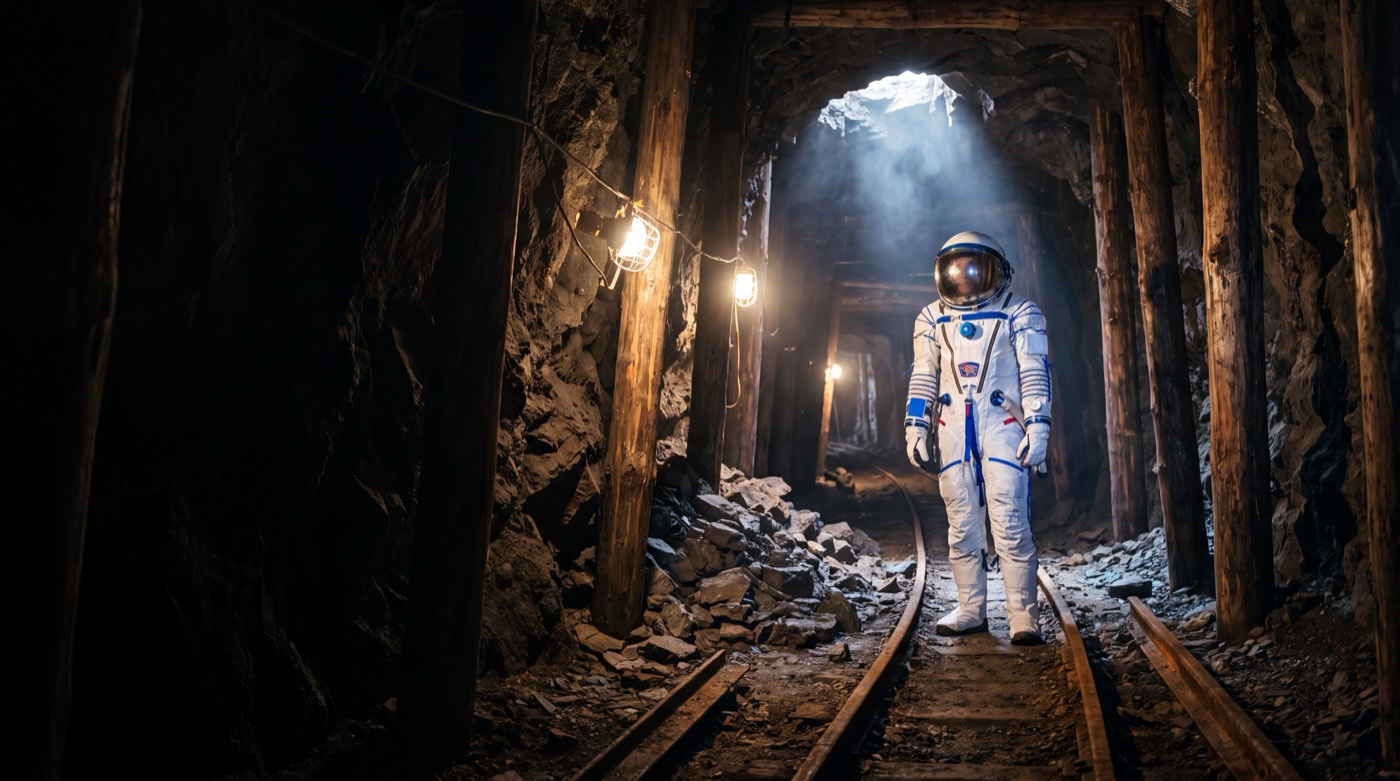
Around the habitat, the concept envisages test ranges: places where rovers, robots and automated mining machines can be trialled in demanding terrain, alongside ISRU technologies — extracting resources on-site, in space. Add to that astrobiology and closed-loop vertical farming and hydroponics, without which long-duration missions cannot happen. Some of these technologies are still emerging — and the unfolding race for the cislunar economy will need them.
A shaft as a weightlessness tower
The most unique element is the use of deep mine shafts. The Lechia shaft (formerly Hohenlohe) was deepened in the 1930s to around 629 metres. That depth opens the door to a facility virtually unmatched in Europe: a drop tower that, on Earth, can sustain an unusually long period of weightlessness or reduced gravity. For research and pre-mission equipment testing, that is a condition hard to overstate.
On the surface: pre-launch testing
The project doesn't end underground. The surface zone is a base for satellite testing: vibration, thermal, vacuum and radiation laboratories — the full set of trials every device must pass before reaching orbit. Many of these laboratories simply don't exist in Poland. Today Polish companies travel abroad, sometimes far, for testing; a facility of their own would cut those costs and keep expertise in the country.
The biggest benefit? For startups
At a meeting with the industry, representatives of major space companies said outright that such infrastructure would offer them real support and cost savings. But — as Rożek stresses is more important — it would deliver the greatest value to startups and young companies, for whom the entry threshold into space testing is usually too high today. On top of this comes an educational layer: a technology park, a science centre popularising knowledge about space, and support for teachers, with the outline of an educational programme already in place.
Why Wujek specifically
The choice of mine is no accident. Wujek has excellent road and rail links, sits right in the heart of the conurbation, has no methane issues, and mining there already ended in 2021 — some seams had earlier been adapted for training purposes. There's also a symbolic reason: at Wujek, the transformation from one economy and one technology to another will be most visible. Formally, since 1 April 2026 the mine has been in liquidation, transferred to Polska Grupa Górnicza's Mine Liquidation Plant.
What stage the project is at
Today the project stands at a 'handful of green lights' stage. The concept is being reviewed by the Ministry of Science and Higher Education, and it has won the backing of three ministers — Science Minister Marcin Kulasek, State Assets Minister Wojciech Balczun, and Deputy Energy Minister Marian Zmarzły — along with a pledge to fund a feasibility study. The project is also supported by the University of Silesia, the City of Katowice, the Upper Silesian-Zagłębie Metropolis and Polska Grupa Górnicza.
If built as described in the report, it could become one of the largest facilities of its kind in Europe and a strategic hub for the space sector in Central and Eastern Europe. The project fits the global new space trend, Poland's growing involvement in European Space Agency programmes, and the new race — this time to the Moon. For now this is a concept and a feasibility study, not a shovel in the ground. But the fact that the report has reached ministers' desks shows the 'out there' idea is being taken seriously.
Editorial material by Method Press based on the public presentation of Dr Tomasz Rożek's concept ('Nauka. To Lubię' Foundation, YouTube channel video) and press reports: PAP 'Nauka w Polsce', GeekWeek/Interia, TVN24, WNP, 'Dziennik Zachodni'. The depth of the Lechia shaft (formerly Hohenlohe), approx. 629 m, per Wikipedia (history of the KWK 'Wujek' mine). The project is at the concept and feasibility-study stage; the figures cited are report assumptions, not built infrastructure. Method Press reports on this topic from public sources — Method Group is not a party to the project.