The AI renderer that enters the workflow, not one that sits beside it
VizAcademy's proprietary AI renderer generates visualisations straight from the 3ds Max, SketchUp and Revit viewport — targeting the barrier that generic image generators fail to solve: integration and control, not just frame quality.
Most AI visualisation tools share the same structural problem: they live in a separate browser tab, disconnected from the model the designer is actually working on. You drop in an image or a prompt and get back a striking picture — but one detached from the project's geometry, camera and proportions. The result looks good and cannot be controlled. VizMaker, VizAcademy's proprietary AI renderer, is a direct answer to that disconnect: built to enter the design process, not sit beside it.

The barrier is integration, not image quality
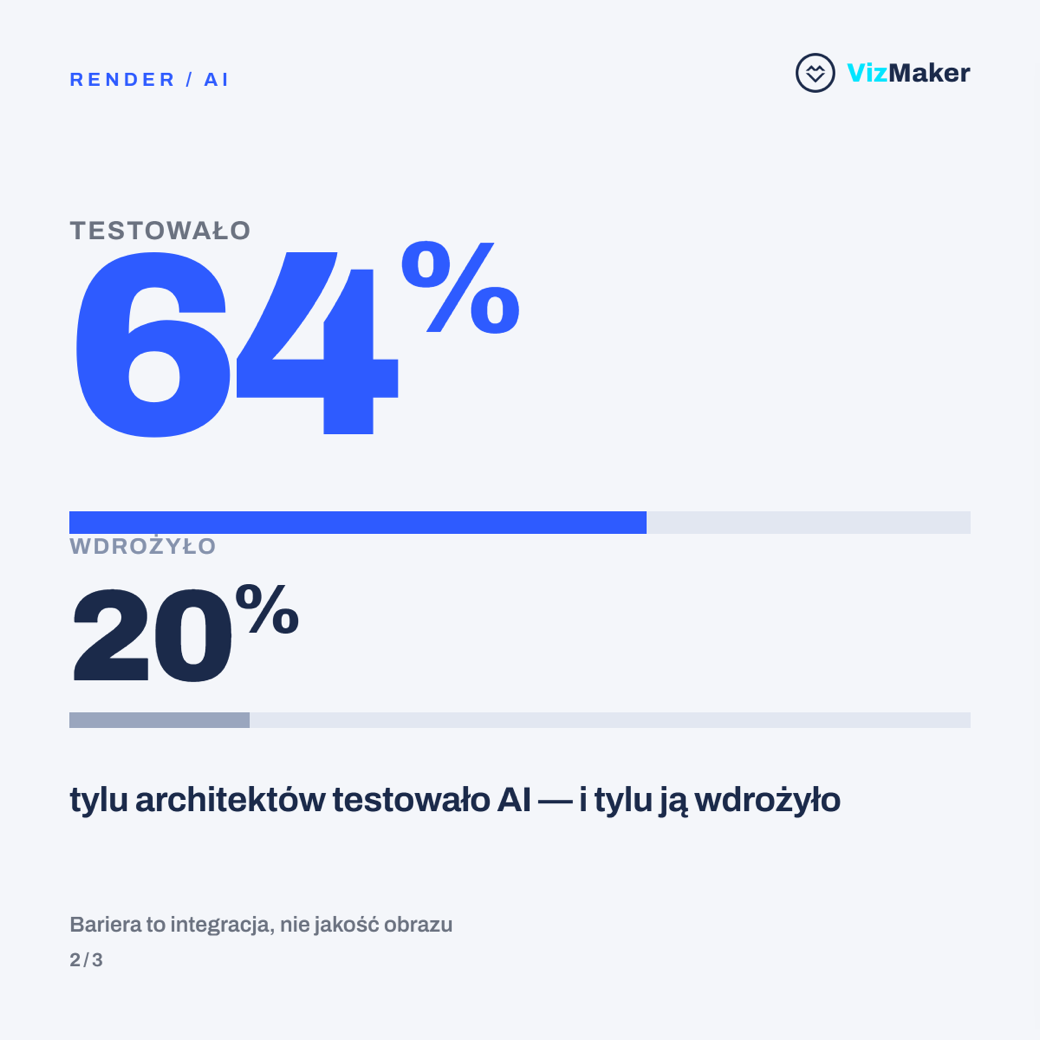
The visualisation market has tested AI, but mostly failed to adopt it. Nearly everyone has tried it; few have built it into a daily, paid process. The reason is not model quality — that keeps improving month on month and cleared the 'looks realistic' bar long ago. It is integration and control: the tool produces a striking frame that cannot be reproduced, fine-tuned, or tied to a specific view and camera. And in commercial visualisation, the client is not buying a 'nice image' — they are buying that specific angle, that massing, that flat.
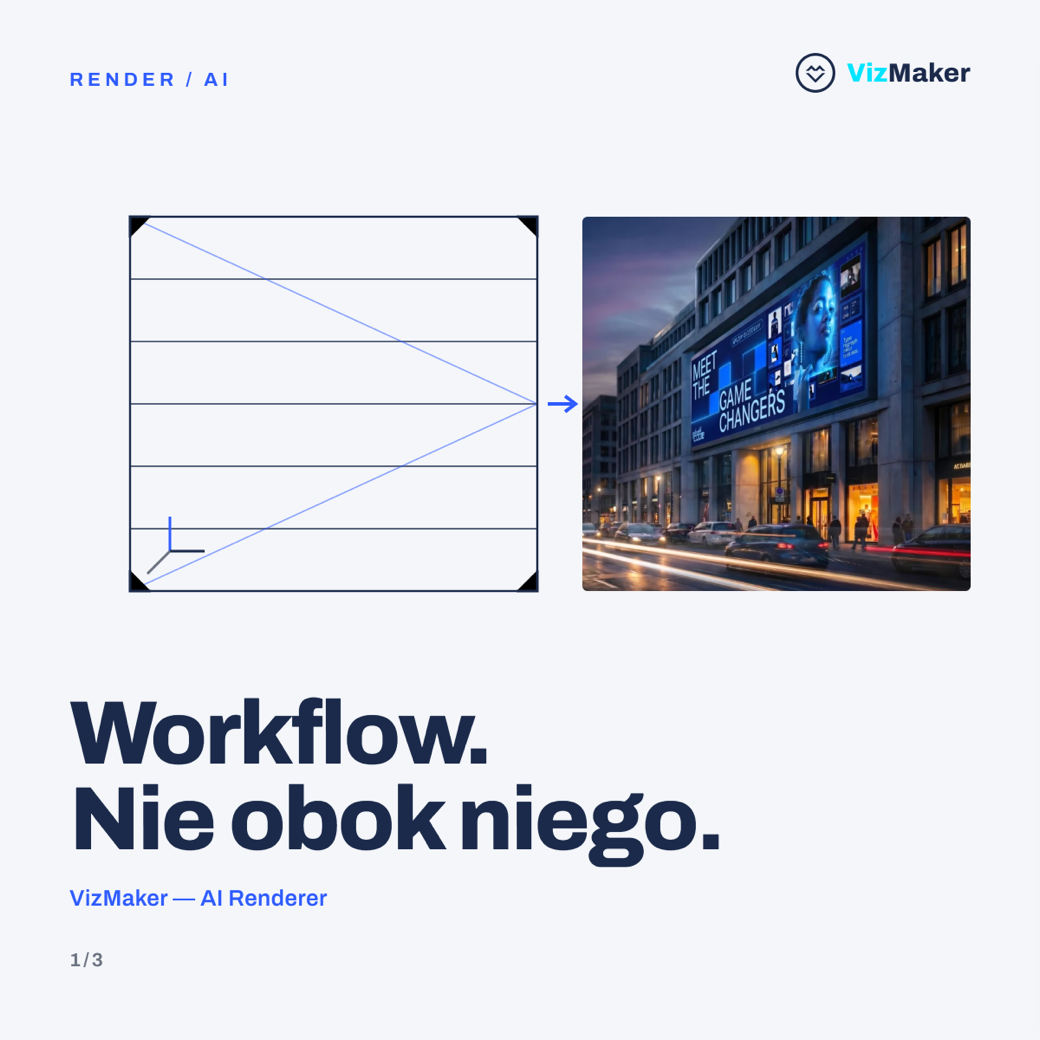
VizMaker targets exactly that gap. Instead of exporting a view and uploading it to an external service, the designer stays inside their own software — the tool reads the massing, composition and camera setup straight from the viewport and builds the image or animation on that basis. That changes the nature of the work: the AI does not guess what the design looks like, it receives its geometry as a starting point.
Local, subscription-based, for professionals
VizMaker runs as a desktop application and computes locally, on the user's machine — which matters both for performance and for the confidentiality of projects that studios do not want sent to third-party servers. The model is subscription-based, with a free trial on entry. The target group is not hobbyists generating images for fun, but professionals: visualisers, interior designers, landscape architects — people for whom the frame is the product they are paid for.
A vertical renderer, not another aggregator
The market has been flooded with platforms promising 'all AI models in one place'. That category has already become commoditised — an aggregator with no value of its own is just a thin layer over someone else's API. VizMaker takes a different route: it is a vertical archviz renderer built into the tools where architecture is actually produced, and its edge lies in the depth of integration and control over geometry, not in the number of models it plugs into.
The market itself confirms the direction. In February 2025, Chaos — the maker of V-Ray, Corona and Enscape, the standards professional visualisation runs on — acquired EvolveLAB, creator of Veras, a tool that integrates AI into the design process. The signal is clear: the future of archviz AI is not standalone image generators, but a layer built into the existing workflow.
Four layers that are hard to copy
The technical edge is compounded by a school-to-tool funnel. VizMaker was built within the VizAcademy ecosystem — a visualisation school — so graduates learn the tool in the training room and carry it straight into work. That is four layers at once: DCC integration, models fine-tuned for archviz specifics, an educational funnel building the user base, and local, Polish-language support. A single feature can be copied in a quarter; a system built from four layers is a far harder target.
'We wanted to build an AI tool that is not a gimmick, but genuinely speeds up the work.' — Anton Revutsky, co-founder of VizAcademy and VizMaker.
This piece concerns the VizMaker brand (VizAcademy) — part of the Method Group ecosystem. Partner / sponsored publication in Method Press. Market references (including Chaos's acquisition of EvolveLAB in February 2025) are drawn from public industry announcements.